
Released alongside the console, the game completely reimagined Mario. Instead of running through traditional side-scrolling levels, players explored a fully 3D castle and entered different worlds through magical paintings.
The Birth of the Nintendo 64
Nintendo released the Nintendo 64 in Japan on June 23, 1996, followed by North American and European launches later that year. It became the successor to the hugely successful Super Nintendo Entertainment System and marked an important turning point in the history of console gaming.
The name “Nintendo 64” came from its 64-bit processor, which Nintendo promoted as a major technological advantage. However, the real revolution was not simply the number 64. The console’s biggest achievement was its ability to create large, colorful and immersive 3D worlds.
At a time when the gaming industry was moving from 2D graphics toward 3D experiences, Nintendo wanted to make this new technology accessible to a massive audience. The Nintendo 64 became one of the consoles that helped define the transition into the modern era of 3D gaming.
Super Mario 64 Changed Everything
If there is one game that represents the Nintendo 64, it is Super Mario 64.
Released alongside the console, the game completely reimagined the Mario formula. Instead of moving through traditional side-scrolling levels, players explored a fully 3D castle and entered different worlds through magical paintings.
The game’s analog controls, camera system and open environments were revolutionary for the time. Players could freely move Mario through three-dimensional spaces, creating a level of freedom that was difficult to imagine in earlier Mario games.
Many modern 3D platformers still use ideas that Super Mario 64 helped establish. For millions of players, it became their first unforgettable experience of true 3D gaming.
Ocarina of Time Became a Legend
Two years later, Nintendo released The Legend of Zelda: Ocarina of Time, pushing the Nintendo 64’s capabilities even further.
The game combined exploration, puzzles, combat and storytelling inside a massive 3D world. Hyrule Field gave players an unprecedented sense of freedom, allowing them to explore a world that felt much larger and more immersive than previous Zelda games.
The game’s Z-targeting system was another major innovation. It provided an effective solution to the difficulty of fighting enemies in a 3D environment and influenced how targeting systems would work in future action games.
Ocarina of Time eventually became widely regarded as one of the most influential and important video games ever created.
GoldenEye 007 and the Rise of Multiplayer
The Nintendo 64 was not only about Nintendo’s first-party games.
GoldenEye 007, developed by Rare, became one of the console’s defining experiences. Its single-player campaign was impressive, but its legendary four-player split-screen multiplayer turned it into a must-have game for gatherings with friends.
Before online multiplayer became standard, four people sitting around a television and competing in a chaotic GoldenEye match was a huge part of the Nintendo 64 experience.
The console helped turn local multiplayer into one of the defining gaming experiences of the 1990s.
Mario Kart 64 and Couch Gaming
Another Nintendo 64 classic was Mario Kart 64.
The game took the popular Super Nintendo formula and transformed it into 3D. It introduced larger tracks, new items and chaotic multiplayer races that quickly became a favorite among Nintendo fans.
But Mario Kart 64 was only one part of the Nintendo 64’s multiplayer appeal.
Games such as Super Smash Bros., Mario Party, GoldenEye 007 and Mario Kart 64 transformed the console into an ultimate couch-gaming machine.
For many retro gamers, Nintendo 64 multiplayer was not simply an additional feature. It was one of the biggest reasons to own the console.
The Nintendo 64 Controller Was Different
The Nintendo 64 controller remains one of the strangest controllers ever designed.
Its unusual three-pronged shape immediately made it stand out from other controllers of the era. However, beneath its strange appearance was one of its most important innovations: the analog stick.
The analog stick allowed players to move characters smoothly through 3D environments instead of relying exclusively on the traditional digital D-pad.
The controller also featured a Z button, shoulder buttons and support for the Rumble Pak, which introduced vibration feedback to compatible games.
Although the controller was not perfect, its design was heavily influenced by the challenges of 3D gaming and helped establish ideas that would become standard in future controllers.
Cartridges Instead of CDs
One of Nintendo’s most controversial decisions with the Nintendo 64 was continuing to use cartridges instead of switching to CDs.
Cartridges had several advantages. They offered fast loading times and were generally more resistant to certain types of physical damage. However, they were considerably more expensive to manufacture and offered significantly less storage capacity than CDs.
This decision created difficulties for some third-party developers and influenced several major publishers to move toward competing platforms that used CD-based media.
Despite these limitations, Nintendo’s first-party developers continued to demonstrate what the Nintendo 64 hardware could achieve.
The Nintendo 64’s Greatest Games
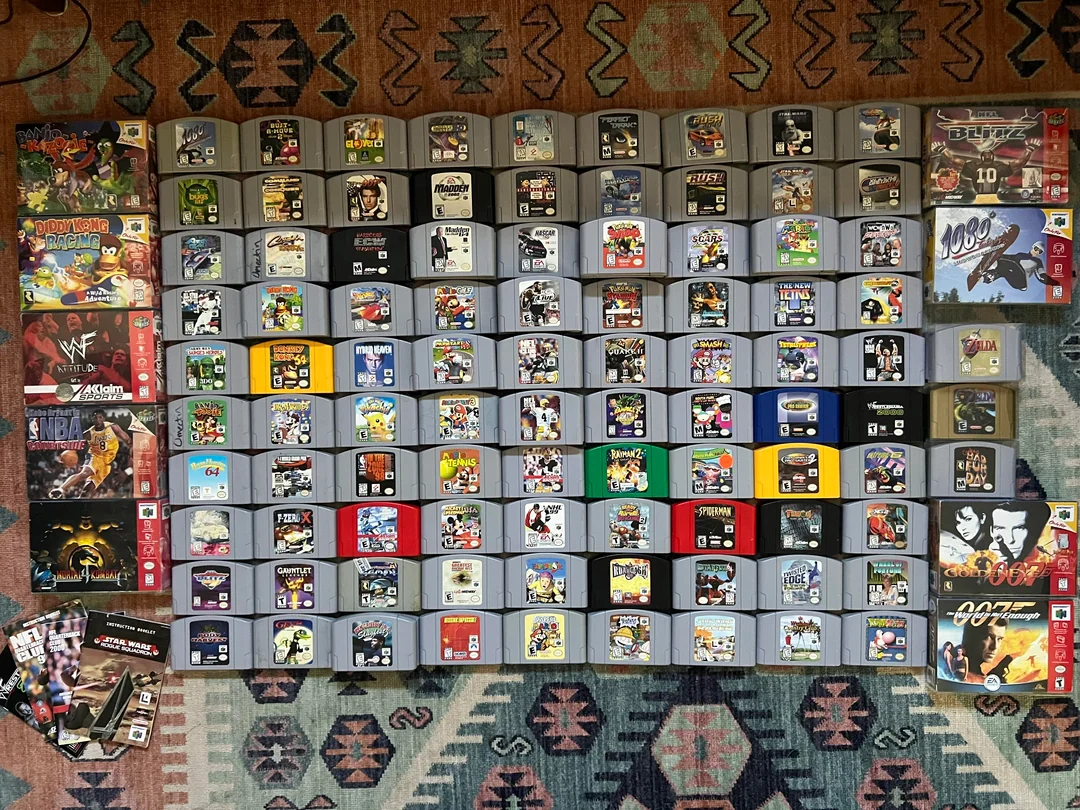
The Nintendo 64 built an incredible library of games that became classics for an entire generation.
Some of its most memorable titles include:
- Super Mario 64
- The Legend of Zelda: Ocarina of Time
- The Legend of Zelda: Majora’s Mask
- GoldenEye 007
- Perfect Dark
- Mario Kart 64
- Super Smash Bros.
- Star Fox 64
- Banjo-Kazooie
- Donkey Kong 64
- Pokémon Stadium
- F-Zero X
- Paper Mario
- Wave Race 64
These games helped establish franchises, gameplay mechanics and multiplayer experiences that continue to influence the gaming industry today.
Why Nintendo 64 Still Matters
The Nintendo 64 was not simply another retro console. It represented a major turning point for the video game industry.
It helped prove that 3D environments could become the future of console gaming. Its analog controls influenced the design of future game controllers, while its multiplayer games created some of the most memorable couch-gaming experiences of the 1990s.
For retro gamers, however, the Nintendo 64 represents more than technological innovation.
It represents memories.
The sound of the console starting up. The click of inserting a cartridge. Sitting on the floor with friends. Exploring Hyrule for the first time. Racing through Rainbow Road. Searching for every star in Super Mario 64.
Those experiences are a major part of what made the Nintendo 64 special.
Nintendo 64: A Retro Gaming Legend
More than 25 years after its original release, the Nintendo 64 continues to inspire gamers and developers.
Its hardware may look primitive compared with today’s consoles, but its games remain enjoyable because great gameplay does not have an expiration date.
The Nintendo 64 helped define an entire generation of gaming. It introduced millions of players to unforgettable 3D worlds, innovative controls and legendary multiplayer experiences.
For those who grew up with the console, the Nintendo 64 is more than a piece of gaming history.
It is a reminder of a time when discovering a new 3D world felt completely magical — and for many players, the memories of those 64-bit adventures will never disappear.